The Women Who Hold the Pantry Together: Documenting the Unrecognized Labor of Immigrant Grandmothers in America's Food Networks
What the Census Doesn't Count
America measures food insecurity in surveys. It counts households, tallies program enrollment, and tracks the number of individuals served by food banks and federal nutrition programs. What it does not count—what its instruments are not designed to capture—is the woman who has spent forty years learning how to feed twelve people on what most Americans would consider groceries for four.
She is present in nearly every immigrant neighborhood in the United States. She may be called abuela, nani, yiayia, or halmeoni. She is the grandmother, the great-aunt, the matriarch who arrived in this country with a set of knowledge so practical and so refined that it constitutes, without exaggeration, a food security system in herself.
Her labor does not appear in economic statistics. Her expertise is not consulted by food policy bodies. And yet, in the daily arithmetic of family survival, she is frequently the most important variable.
The Architecture of Stretch
The knowledge that older immigrant women carry about food is not sentimental. It is technical. It encompasses purchasing strategy—knowing which markets discount produce at the end of the day, which cuts of meat yield the most nutrition per dollar, which dried ingredients can substitute for fresh ones without sacrificing the integrity of a dish.
It encompasses preservation. Women who grew up in households without reliable refrigeration or consistent grocery access learned to ferment, dry, pickle, and salt with a precision that modern food science has largely rediscovered and rebranded. A grandmother who makes kimchi in a Queens apartment, or who dries chili peppers on a Houston balcony, is not practicing a quaint cultural tradition. She is extending the life of food in ways that reduce waste and stretch household budgets across weeks rather than days.
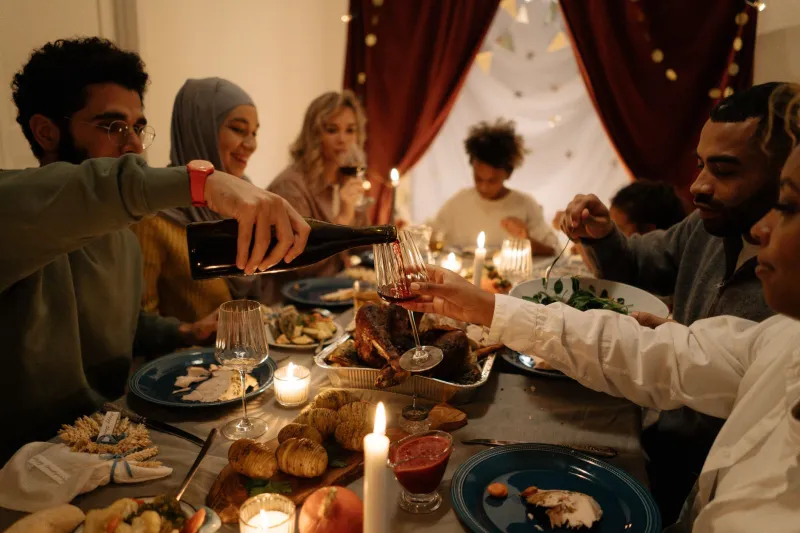
And it encompasses distribution. Many older immigrant women manage informal networks of food sharing that extend well beyond their immediate households. A pot of soup becomes dinner for a neighbor recovering from illness. A surplus of homemade bread moves quietly through a building. Extended family members who are newly arrived and disoriented are fed without fanfare and without bureaucratic process, because the woman who feeds them has decided that this is simply what one does.
This informal distribution is, by any reasonable definition, a food security intervention. It is simply one that no program takes credit for and no funder supports.
Carrying Knowledge Across Generations
Beyond the economics of the pantry, older immigrant women are the primary custodians of a form of nutritional knowledge that is genuinely difficult to replicate. The understanding of how to use the whole animal, how to build flavor from inexpensive aromatics, how to make a nutritionally complete meal from grains and legumes rather than expensive protein—this knowledge was developed over generations in response to real scarcity and has been refined through decades of practice.
In communities across the United States, this knowledge is at risk of being lost. As younger generations assimilate into American food culture—which tends toward convenience, individual portions, and processed ingredients—the granular, embodied expertise of their grandmothers is not automatically transferred. The recipes may survive in written form. The judgment that makes them work—the ability to taste, adjust, improvise, and teach—is far more fragile.
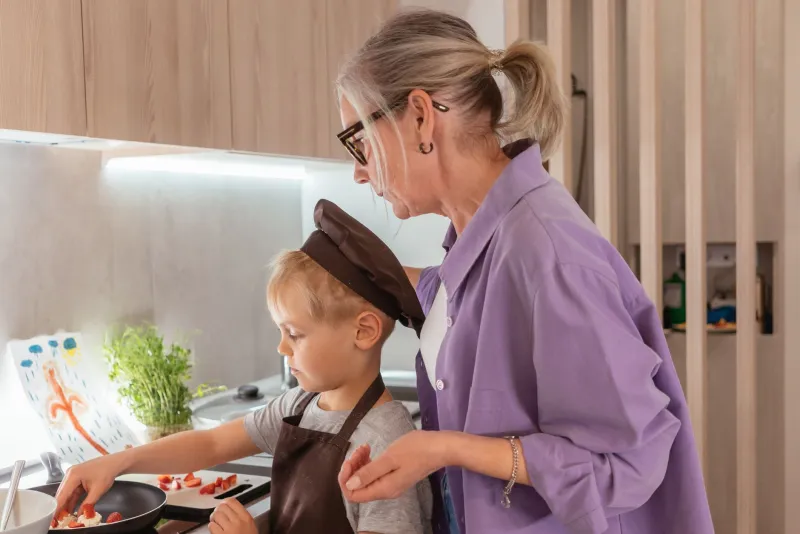
Community organizations that have recognized this have begun creating structured opportunities for intergenerational knowledge transfer: cooking programs that pair older immigrant women with younger family members or community participants, oral history projects that document food knowledge alongside cultural memory, and teaching kitchen initiatives that position grandmothers as instructors rather than beneficiaries.
These efforts are valuable, but they remain scattered and underfunded relative to the scale of what is at stake.
The Vulnerability Behind the Strength
It would be a disservice to document the contributions of older immigrant women without also documenting their circumstances. The same women who quietly anchor their communities' food security are frequently among the most economically and socially vulnerable members of those communities.
Many arrived in the United States later in life, following adult children, and have not accumulated the work history required for Social Security benefits. Their income may be entirely dependent on family members whose own financial situations are precarious. Language barriers limit their ability to navigate public benefit systems, and cultural norms around self-sufficiency and family privacy may prevent them from seeking help even when they are eligible for it.
Isolation is another dimension of this vulnerability. Women who have spent decades as the center of a household food network may find themselves increasingly alone as family members disperse, as mobility decreases, and as the neighborhoods around them change. The same capacity for informal food sharing that made them essential to others becomes difficult to sustain when they are no longer embedded in the dense social fabric that made it possible.
For community organizations, this presents both a moral imperative and a practical opportunity. Older immigrant women are not simply service recipients waiting to be identified. They are potential partners, advisors, and program leaders whose expertise and community relationships are assets of genuine value. Programs designed with this recognition—rather than around the assumption of deficit—tend to produce better outcomes for everyone involved.
What Policy Could Learn From the Pantry
If food policy bodies were to take seriously the knowledge and labor of older immigrant women, several implications would follow. Community food programs would be designed with cultural specificity rather than cultural neutrality, acknowledging that what nourishes one community may not nourish another and that the women who carry this specificity deserve a seat at the design table.
Nutrition education programs would shift from instruction to dialogue, recognizing that the women they serve are not blank slates but experienced practitioners with expertise worth documenting and disseminating. And economic support programs would account for the informal labor that older immigrant women contribute—labor that currently subsidizes the formal food system without receiving any formal recognition.
None of this requires inventing new frameworks. It requires looking honestly at what is already happening in neighborhoods across the country and building systems worthy of the people who have been quietly holding those neighborhoods together.
The pantry is already full of wisdom. The question is whether we are paying attention.