Beyond the Doctor's Coat: South Asian American Youth and the Freedom to Choose a Different Path
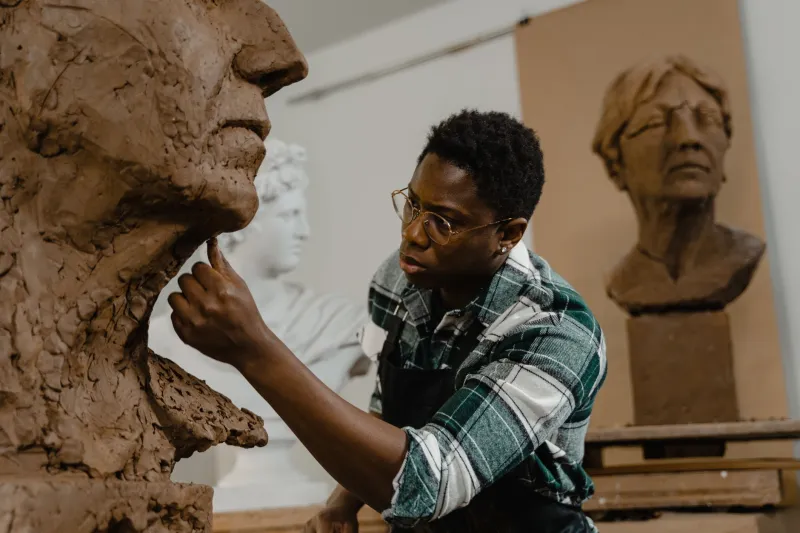
Somewhere in the United States right now, a South Asian American teenager is sitting across from a guidance counselor, listing the careers her parents have approved: physician, software engineer, attorney. She is not unhappy, exactly. She simply cannot locate herself anywhere in that list.
This is a familiar story. It plays out in living rooms, at family dinners, and in the quiet calculations of young people who have learned — often without being told directly — that certain ambitions are acceptable and others are not. The pressure is rarely cruel. It is almost always loving. And that is precisely what makes it so difficult to resist.
The Architecture of Expectation
The concentration of South Asian Americans in a handful of professional fields is well documented. Physicians, engineers, and technology professionals of South Asian descent are represented in the United States at rates that far exceed their share of the general population. This is, in many respects, a story of remarkable achievement — the result of generations of sacrifice, discipline, and determination.
But achievement and fulfillment are not the same thing. And the architecture of expectation that produces these outcomes carries costs that are less frequently examined.
For many South Asian American families, the emphasis on particular careers is rooted in a specific historical experience. The first and second generations of South Asian immigrants arrived in the United States often through pathways that selected for professional credentials — the Hart-Celler Act of 1965 prioritized skilled workers, and many early South Asian immigrants were physicians, scientists, and engineers who had already demonstrated exceptional academic performance. The lesson that was passed down, consciously or not, was that professional credentials were the most reliable form of security in an uncertain country.
That lesson made sense in its original context. The question now is whether it continues to serve the generation that inherited it.
The Psychological Weight of a Predetermined Life
The mental health implications of navigating rigid family expectations are significant. Research on South Asian American communities has consistently identified elevated rates of anxiety and depression among young adults who experience conflict between their own aspirations and those of their families. The particular quality of this distress — rooted not in hostility but in love, not in failure but in the fear of disappointing people who have sacrificed enormously — can be especially difficult to process.
"The hardest part is that you cannot be angry about it," said one South Asian American woman in her late twenties, now working as a graphic designer in New York after years of studying pre-medicine. "Your parents did everything right. They worked incredibly hard. They just wanted you to be safe. How do you explain that safety is not the same as happiness?"
This emotional complexity — gratitude and grief occupying the same space — is one reason why so many South Asian American young people delay or suppress the conversation about career autonomy. It is also why mental health professionals who work with this population emphasize the importance of framing these conversations not as rejections of family values but as extensions of them.
The Artists, Activists, and Unconventional Professionals
Across the United States, a generation of South Asian Americans is building careers that would have been unimaginable to their parents — and doing so with a growing sense of both pride and purpose.
There are South Asian American filmmakers whose work is being screened at major festivals, exploring stories of diaspora, identity, and belonging that have long been underrepresented on American screens. There are community organizers working in housing justice, immigration advocacy, and environmental policy, drawing on a deep sense of cultural obligation to public service. There are chefs, writers, musicians, social workers, and educators who have chosen depth of meaning over markers of prestige.
What is notable about many of these individuals is not that they rejected their families outright — most did not. Rather, they found ways to honor the underlying values their families held (hard work, service, contribution, integrity) while applying those values to paths their families had not initially envisioned.
"My father wanted me to be an engineer because he believed in building things that last," said one South Asian American architect and community designer based in Los Angeles. "When I finally showed him what I was building — affordable housing, community spaces — he understood. The value was always the same. Just the expression of it was different."
A Practical Framework for Parents and Young Adults
Changing deeply embedded cultural patterns requires more than individual courage. It requires new frameworks for conversation — ones that acknowledge both the legitimacy of parental concern and the authenticity of individual aspiration.
For parents, mental health advocates recommend beginning with curiosity rather than correction. Asking a child what they find meaningful, what problems they want to solve, and what kind of life they want to live is a different conversation than asking what career they intend to pursue. The former opens possibilities; the latter often forecloses them.
For young adults, the challenge is often one of translation — learning to articulate unconventional ambitions in terms that resonate with family values. A career in public health may not be medicine, but it addresses the same underlying commitment to healing. A career in education technology may not be engineering, but it applies the same rigor to a different kind of problem.
Community organizations, including those focused on South Asian diaspora populations, have an important role to play in this process — creating spaces where these conversations can happen across generations, with honesty and without shame.
Rewriting the Script
The goal is not to devalue the careers that South Asian American families have long honored. Physicians, engineers, and attorneys do vital, meaningful work. The goal is to expand the definition of a life well lived — to make room for the artist, the activist, the entrepreneur, the social worker, and the dreamer alongside the doctor and the engineer.
The bhandara tradition that inspires this community network is, at its core, about abundance — not scarcity. It is about a table large enough to hold everyone, with room for many kinds of nourishment. The same generosity of spirit that sets that table wide can be extended to the dreams of the next generation.
Permission, it turns out, may be the most nourishing thing a community can offer.