After the Shelves Go Empty: How Local Food Networks Are Building the Resilience America's Supply Chain Cannot
In March of 2020, the pasta aisle at a suburban grocery store in Columbus, Ohio, became a kind of cultural symbol. Bare metal shelves where boxes of spaghetti had been stacked just days earlier told a story that most Americans had never expected to read: the food system they had taken for granted was, in fact, deeply fragile.
Within weeks, food banks across the country were reporting demand increases of forty, sixty, even one hundred percent. Distribution networks buckled. Produce rotted in fields because the labor infrastructure to harvest it had collapsed. Meat processing plants became outbreak epicenters, forcing closures that cascaded through supply chains already stretched thin. For millions of households, especially those already navigating poverty, the disruption was not an inconvenience — it was a crisis that threatened basic survival.
Four years later, the shelves are restocked. But the lesson has not been forgotten by the communities that were most exposed.
A System Built for Efficiency, Not Durability
America's modern food supply chain is, by almost any engineering measure, a marvel. It moves billions of pounds of food across thousands of miles with extraordinary speed and precision. A head of lettuce grown in California's Salinas Valley can appear on a dinner table in Maine within days. Strawberries arrive in Chicago in January. The system is optimized relentlessly for cost and efficiency.
But efficiency and resilience are not the same thing. In fact, they are often in tension. A system built to minimize slack — to carry as little excess inventory as possible, to consolidate processing into as few facilities as possible, to rely on as few suppliers as possible — is a system with very little capacity to absorb shocks. When one node fails, the effects ripple outward with speed proportional to the system's interconnectedness.
This is not a new observation among food systems scholars. What is new is the urgency with which communities are acting on it.
Seed Libraries and Soil: The Long Game of Food Sovereignty
In Tucson, Arizona, the Native Seeds/SEARCH organization has been collecting and preserving drought-adapted seeds from the American Southwest and northern Mexico for more than four decades. What began as an act of cultural preservation has become, in the post-pandemic era, increasingly recognized as critical resilience infrastructure.
Seed libraries — community repositories where residents can borrow seeds, grow food, and return a portion of the harvest's seeds for others — have proliferated across the country in recent years. According to the Seed Library Social Network, there are now more than six hundred public seed libraries operating in the United States, housed in public libraries, community centers, and agricultural extension offices.
The logic is straightforward: a community that controls its own seed supply is a community that cannot be entirely at the mercy of corporate agricultural supply chains. When commercial seed availability is disrupted — as it was in 2020, when stratospheric demand for home garden seeds overwhelmed major suppliers — a local seed library becomes something more than a curiosity. It becomes a lifeline.
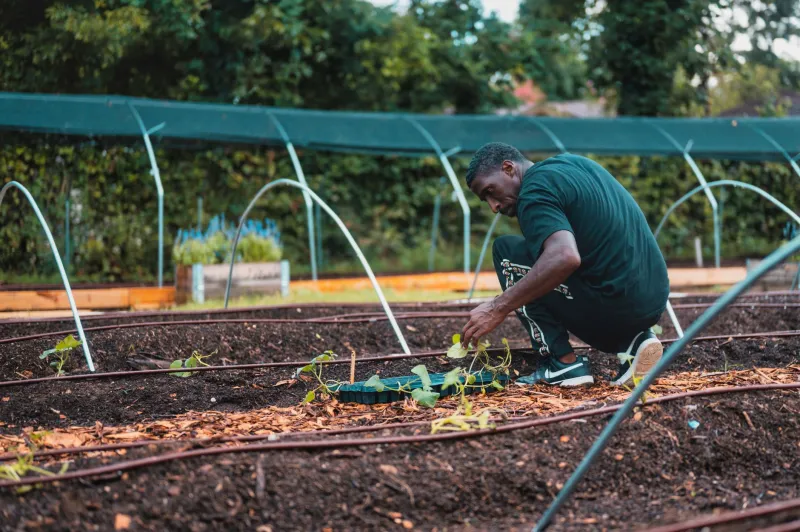
Similar thinking is driving investment in urban agriculture, community gardens, and rooftop growing operations in cities from Detroit to Denver. These efforts rarely produce enough food to feed a neighborhood on their own. But they contribute to a diversified local food landscape that is meaningfully more resilient than one dependent entirely on distant supply chains.
The Mutual Aid Lesson
Perhaps the most significant resilience infrastructure to emerge from the pandemic era was not physical at all. It was relational.
Mutual aid networks — informal, community-organized systems of neighbor-to-neighbor support — exploded in number and scale beginning in spring 2020. In New York City alone, more than one hundred neighborhood mutual aid groups formed within weeks, coordinating grocery deliveries for elderly and immunocompromised residents, sharing surplus food, and connecting people with resources that formal systems had failed to provide.
What distinguished these networks from traditional charity models was their structure: they were horizontal rather than hierarchical, driven by the principle that everyone in a community has something to offer and everyone has needs. A retired schoolteacher who could not leave her apartment could still make phone calls to check on neighbors. A restaurant worker who had lost their job could still deliver groceries on a bicycle.
Many of these networks have persisted and matured. In Richmond, Virginia, the Richmond Mutual Aid network has evolved into a standing community organization with established food distribution protocols, a volunteer coordination system, and relationships with local farms and food businesses that allow it to mobilize quickly when need arises. It is, in effect, a community food resilience system that exists independently of government programs or corporate supply chains.
This is the spirit that animates the bhandara tradition — the understanding that communities sustain themselves through collective care, that the act of feeding one another is not a transaction but an expression of shared humanity. Building resilient food systems requires that same spirit at an institutional scale.
Learning From Natural Disasters
The pandemic was not the only teacher. Communities along the Gulf Coast, in Puerto Rico, in the Ohio River Valley, and across the rural South have spent years developing food resilience strategies born of experience with hurricanes, floods, and ice storms that sever supply lines for days or weeks at a time.
After Hurricane Maria devastated Puerto Rico's food system in 2017 — exposing the island's dangerous dependence on imported food for nearly eighty-five percent of its supply — a wave of agricultural revitalization efforts emerged. Organizations like Organización Boricuá de Agricultura Ecológica began building networks of small-scale agroecological farms, seed exchanges, and food sovereignty education programs. The goal was not simply to grow more food, but to rebuild the knowledge, relationships, and infrastructure that would allow Puerto Rican communities to feed themselves in the absence of external support.
On the mainland, similar lessons are being drawn. In Appalachian Kentucky, where geographic isolation amplifies the impact of any supply chain disruption, community organizations are investing in local food hubs — facilities that aggregate, process, and distribute food from regional farms to local institutions, reducing dependence on distant distribution networks.
Building Forward, Not Just Recovering
The shift from emergency response to proactive resilience-building is not merely strategic. It reflects a deeper philosophical reorientation: the recognition that vulnerability to food supply disruption is not a natural condition but a policy choice — one that has consistently imposed the greatest costs on communities that were already most marginalized.
Building local food resilience is, therefore, an act of advocacy as much as logistics. It is a community asserting that its members deserve stable, dignified access to food regardless of what happens in distant processing plants or global shipping lanes.
The infrastructure being built — seed libraries, urban farms, mutual aid networks, regional food hubs, community-owned cold storage — is imperfect and incomplete. No local food system can fully insulate a community from the shocks of a globalized economy. But every node added to that network is a node that did not exist before. Every relationship built between a community organization and a local farmer is a relationship that can be activated when the shelves go empty again.
And they will go empty again. The question is whether communities will be ready.