Feasting as Infrastructure: What Ancient Communal Food Traditions Reveal About Ending Food Deserts
When the Tradition Meets the Crisis
In neighborhoods across the United States—from the South Side of Chicago to the Mississippi Delta to the high-desert communities of New Mexico—the absence of accessible, nutritious food is not an accident. It is the accumulated result of decades of disinvestment, discriminatory zoning, and market forces that deemed certain communities insufficiently profitable to serve. The term "food desert" has become a fixture of policy language, but the clinical label obscures something far more personal: the daily exhaustion of families who must travel miles for a head of broccoli, who rely on corner stores for dinner, who watch their children grow up without the basic fuel that learning and thriving require.
Conventional responses to this crisis have cycled through familiar forms. Food banks collect and distribute. Voucher programs extend purchasing power. Mobile markets make occasional appearances. Each of these interventions carries genuine value, and each also carries a quiet limitation: they respond to the absence of food without fundamentally restructuring the conditions that produce that absence.
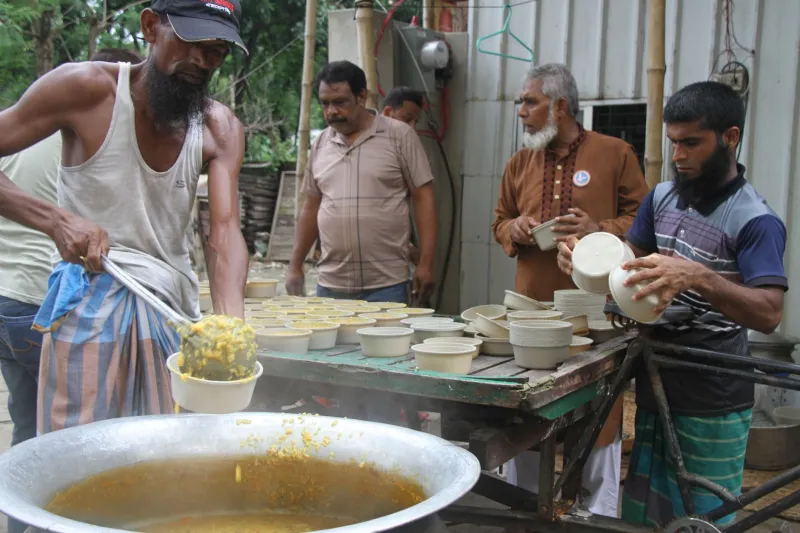
The bhandara tradition—practiced for centuries across South Asian communities as a form of unconditional communal feeding—offers a different way of seeing the problem entirely. In the bhandara model, food is not a resource rationed to those who qualify. It is a social infrastructure, as essential and as deliberately built as roads or schools. Everyone eats. No one is assessed. The meal itself is the message: you belong here, and your nourishment matters.
Organizations across the country are now asking a practical question: What happens when you apply that logic to a food desert?
The Architecture of Abundance
The bhandara model rests on several structural principles that distinguish it from charitable food distribution. First, it centralizes cooking rather than merely distributing ingredients or packaged goods. Second, it treats the meal as a social event rather than a transaction—people gather, sit together, and share the experience of eating. Third, it is designed to be repeatable and community-sustained rather than dependent on outside donors arriving on a schedule.
In East Oakland, California, a community kitchen collective called Roots & Tables has spent the past five years operationalizing something close to this vision. Founded by a coalition of Black and Latinx residents who were frustrated with the stop-and-start nature of emergency food aid, the organization occupies a former warehouse that now houses a commercial kitchen, a dining hall, and a small urban garden. Three evenings a week, the kitchen produces a full hot meal served to anyone who walks through the door—no sign-up, no income verification, no explanation required.
"We stopped asking people to prove they needed to be here," says one of the collective's founding members. "When you stop asking that question, the whole feeling of the room changes. People come because they want to, not because they're desperate."
The meal program is supported by a combination of sliding-scale community memberships, catering revenue from the commercial kitchen, and grants—a diversified model that reduces dependence on any single funding stream and gives the organization genuine staying power.
From Emergency to Ecosystem
What makes the bhandara-inspired approach particularly compelling in the context of food deserts is its insistence on permanence. Emergency food systems are, by design, temporary responses to acute need. But food deserts are not emergencies in the conventional sense. They are chronic conditions, built into the landscape over generations. Addressing them requires infrastructure that operates on a similarly long timeline.
In Louisville, Kentucky, a faith-based organization called The Common Table has spent a decade building what its director describes as a "neighborhood food ecosystem" in a predominantly Black community where the nearest full-service grocery store is more than three miles away. The ecosystem includes a weekly community meal, a small-scale food cooperative stocked with produce grown in adjacent community gardens, a cooking education program for adults and youth, and a network of neighborhood "food stewards"—trained residents who connect neighbors to resources and help troubleshoot access barriers.
The weekly meal sits at the center of this ecosystem not simply as a feeding mechanism but as a convening point. It is where new residents learn about the cooperative. It is where cooking class graduates practice the skills they've developed. It is where the organization's leadership—drawn entirely from the community it serves—hears directly from the people most affected by local food conditions.
"The meal is how we stay connected to what's actually happening," the director explains. "It's not a program. It's a relationship."
Dignity as Design Principle
Perhaps the most significant lesson that the bhandara tradition offers to American food justice work is the insistence that dignity is not a feature to be added to a food program—it is the foundation on which the program must be built.
Traditional food charity, however well-intentioned, often communicates a hierarchy: there are those who have enough to give, and those who do not have enough to eat. The act of receiving is freighted with that hierarchy, and many people—particularly those who have experienced other forms of marginalization—find the weight of it too heavy to bear. Studies consistently show that a significant portion of food-insecure Americans do not access available assistance programs, and shame is among the most commonly cited reasons.
The communal meal model disrupts that hierarchy by making the act of eating together the primary event. When everyone in a room is seated at the same table, eating the same food, the social calculus shifts. The distinction between giver and receiver blurs. What remains is simply the community, sharing a meal.
This is not merely symbolic. Research in community health and social psychology has documented measurable differences in outcomes between food programs that emphasize dignity and those that do not—including higher rates of return participation, stronger social connection among participants, and greater willingness to engage with adjacent services like health screenings or job training.
Building the Blueprint Forward
The organizations adapting bhandara principles in American food deserts are not operating from a single playbook. They vary in scale, in funding strategy, in the specific communities they serve, and in the precise mix of services they offer. What they share is a foundational conviction: that the solution to food access is not more efficient charity but more deliberately designed community infrastructure.
For policymakers and funders paying attention, that distinction carries real implications. It suggests that investments in permanent community dining spaces, commercial kitchen infrastructure, and community-led food cooperatives may yield more durable results than repeated rounds of emergency food grants. It suggests that the people living in food deserts are not passive recipients of solutions designed elsewhere but essential architects of the systems that will actually work for them.
The bhandara tradition endured for centuries not because it was administered by outside institutions but because communities claimed it as their own. That ownership—the sense that the meal belongs to everyone who gathers for it—is precisely what the most promising American adaptations are working hardest to replicate.
In a country that has long treated food access as a matter of individual responsibility and market efficiency, that is a genuinely radical proposition. And in the neighborhoods where it is taking root, it is also beginning to work.