Where Grandmothers Lead: How Intergenerational Kitchens Are Becoming Unlikely Cornerstones of Food Justice
There is a particular kind of knowledge that cannot be found in a cookbook. It lives in the hands of a seventy-three-year-old woman who learned to press masa from her mother on a kitchen floor in Oaxaca, or in the quiet confidence of a grandmother in rural Mississippi who has been seasoning cast iron skillets and slow-cooking collard greens for five decades. This knowledge — embodied, relational, and deeply tied to cultural survival — is now at the center of a growing movement that recognizes the community kitchen not merely as a place to prepare food, but as a site of healing, transmission, and justice.
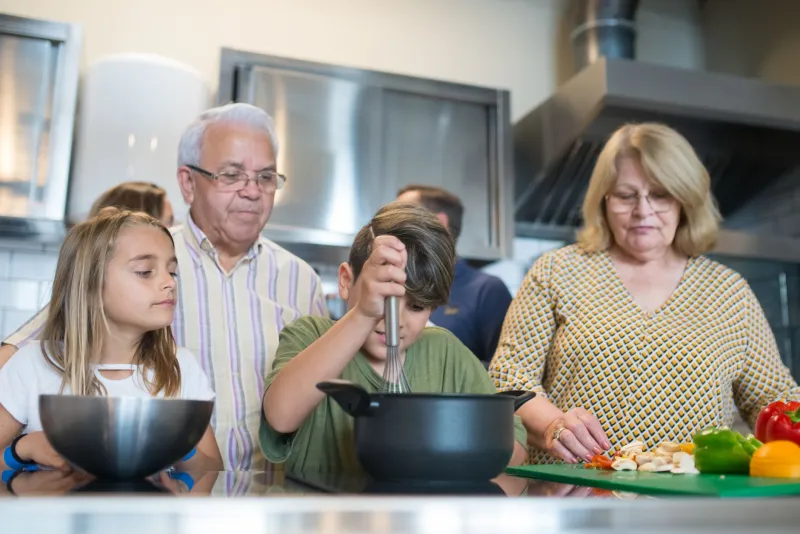
Across the United States, a new generation of community organizations is deliberately designing programs that bring elders and younger residents together around the act of cooking. These intergenerational kitchen initiatives are proving to be far more than culinary exercises. They are, in effect, rebuilding the connective tissue of communities that have been frayed by poverty, displacement, and the particular loneliness that accompanies aging in an era of social fragmentation.
The Two Crises These Programs Address at Once
The United States is, by most measures, experiencing two parallel emergencies that rarely appear in the same policy conversation. The first is food insecurity: according to the USDA, tens of millions of Americans — including a disproportionate number of people of color and residents of low-income urban and rural communities — lack consistent access to nutritious, culturally appropriate food. The second is a loneliness epidemic among older adults. Research from the National Academies of Sciences, Engineering, and Medicine has found that approximately one-quarter of community-dwelling Americans aged 65 and older are socially isolated, a condition linked to cognitive decline, cardiovascular disease, and premature mortality.
Intergenerational kitchen programs sit at the precise intersection of these two crises. By creating structured, recurring opportunities for elders and younger community members to cook together, these initiatives address food insecurity through education and resource-sharing while simultaneously providing seniors with the social connection, sense of purpose, and community recognition that can counteract isolation. The elegance of the model lies in its refusal to treat either problem in isolation.
Preserving What Cannot Be Digitized
One of the most consequential — and least discussed — dimensions of this work is cultural preservation. Across immigrant communities and communities of color throughout the United States, the recipes, techniques, and food traditions that define cultural identity are frequently stored not in written form, but in the lived memory of elder women. As these women age and their communities face ongoing displacement, gentrification, and assimilation pressures, an irreplaceable archive of culinary and cultural knowledge is at genuine risk of disappearing.
Programs that intentionally center grandmothers and elder women as teachers and knowledge-holders create structured pathways for this transmission. In cities like Chicago, Los Angeles, Detroit, and Houston — where immigrant communities have established deep roots across multiple generations — community organizations have documented significant interest among younger residents in reconnecting with food traditions that their own upbringings, shaped by assimilation and economic pressure, may have interrupted. The intergenerational kitchen becomes, in this context, a form of living archive: dynamic, relational, and continuously renewed.
This is not merely about nostalgia. Cultural foodways carry within them nutritional wisdom, medicinal knowledge, and ecological relationships with local ingredients that have been refined over centuries. When a Somali grandmother teaches a group of teenagers in Minneapolis how to prepare suqaar with proper spicing, or when a Vietnamese elder in San Jose guides a young family through the preparation of a traditional pho broth, the knowledge being transferred encompasses far more than a recipe. It is a comprehensive orientation toward food, health, and community that has sustained generations.
Models That Are Working
Several organizations across the country have developed replicable models worth examining closely.
In Philadelphia, a community health organization has embedded what it calls "elder kitchen mentors" into its broader food access programming. Seniors — recruited through senior centers and faith communities — are paid a modest stipend to serve as weekly cooking instructors in a shared kitchen space. Participants from the broader community, including young adults enrolled in job-training programs, attend not merely to learn recipes but to engage in structured intergenerational conversation about food history, family memory, and community identity. Evaluations of the program have documented measurable reductions in reported loneliness among participating seniors, alongside improved nutritional literacy among younger participants.
In New Mexico, a tribal community organization has formalized a similar model centered specifically on Indigenous foodways, pairing elder women with youth in the preparation of traditional foods using locally grown and foraged ingredients. The program has become a vehicle for broader language and cultural revitalization efforts, with cooking sessions conducted in the tribal language whenever possible.
In Atlanta, a food justice nonprofit has taken the model in a different direction, training elder women from historically underserved neighborhoods as paid community nutrition educators who lead cooking demonstrations at farmers markets, community centers, and public housing complexes. These women — many of whom had never previously been compensated for the expertise they had spent lifetimes developing — describe the program as transformative not only in economic terms but in terms of how their communities see and value them.
Dignity as a Design Principle
What distinguishes the most effective intergenerational kitchen programs from more conventional food education efforts is their foundational commitment to the dignity and authority of elder participants. Rather than positioning seniors as beneficiaries of youth volunteerism or as peripheral figures in programs designed primarily for younger residents, these initiatives explicitly frame elder community members as experts, teachers, and leaders.
This distinction matters enormously. Programs that position grandmothers as the holders of essential knowledge — rather than as recipients of charitable attention — generate fundamentally different outcomes. Participating elders report higher levels of engagement, greater sense of purpose, and stronger social bonds. Younger participants, in turn, develop relationships with elders that are grounded in genuine respect and curiosity rather than in the awkward dynamics of service provision.
For organizations working within the tradition of community-centered service — the conviction that lasting change emerges from within communities rather than being delivered to them from outside — this design principle is not incidental. It is the foundation upon which everything else is built.
A Practice as Old as Community Itself
It is worth noting that what these programs are recovering is not a novel intervention but a restoration of something that human communities have practiced across cultures and centuries: the deliberate transmission of food knowledge from elders to the young, conducted in shared space, through the act of cooking together. The formalization of this practice as a community development strategy reflects, in part, how thoroughly the conditions of modern American life — geographic mobility, digital distraction, economic precarity, and the privatization of domestic life — have disrupted what once occurred naturally.
The growing recognition that this disruption carries real social costs — measurable in rates of isolation, cultural erosion, and nutritional decline — is prompting communities across the country to rebuild these connections with intention and care. In doing so, they are discovering what the bhandara tradition and countless other communal food practices have long affirmed: that the preparation and sharing of food is one of the most powerful instruments available to any community seeking to nourish not only bodies, but bonds.
The grandmother at the head of the kitchen table is not a relic of an earlier era. She is, increasingly, recognized as exactly what she has always been — an anchor, a teacher, and an indispensable force in the ongoing work of building communities worthy of the people who live in them.