The Table as Common Ground: How Shared Meals Are Quietly Stitching America's Torn Social Fabric
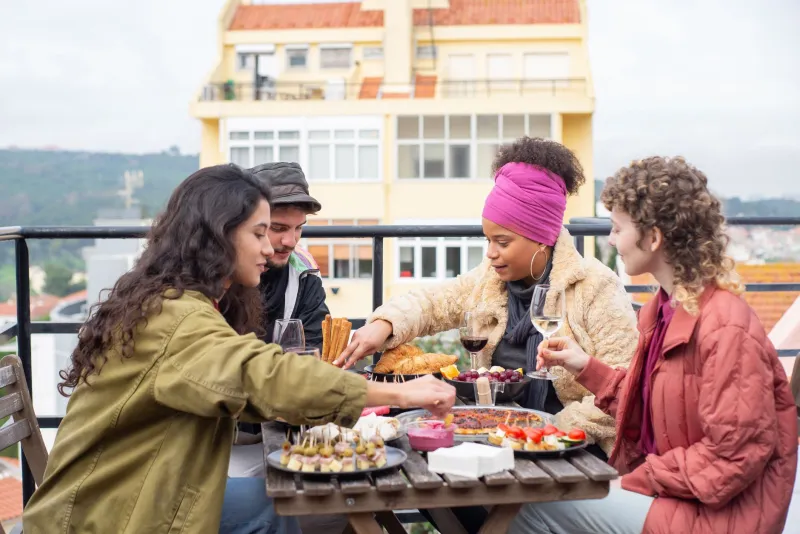
America is hungry in more ways than one. While the crisis of food insecurity commands increasing public attention, a parallel crisis—one that is harder to measure but no less consequential—has been quietly deepening for decades. Americans trust one another less, know their neighbors less, and participate in collective civic life less than at virtually any point in the modern era. The social infrastructure that once held communities together has eroded to the point where many researchers now describe the country as experiencing a loneliness epidemic with structural dimensions.
Against this backdrop, a modest but compelling body of evidence has begun to accumulate around a practice so ancient it predates recorded history: sharing food.
What Happens When Strangers Eat Together
The social science of communal eating is more developed than most people realize. Researchers at Cornell University, the University of Chicago, and Oxford's Institute of Cognitive and Evolutionary Anthropology have each produced findings suggesting that eating together accelerates the development of trust, increases prosocial behavior, and generates what sociologists call "social capital"—the web of relationships, norms, and mutual obligations that make collective action possible.
One mechanism appears to be physiological. Sharing food involves a degree of vulnerability—you are, in the most literal sense, placing something in your body that another person has touched and prepared. This vulnerability, when it goes well, produces a sense of safety that is difficult to generate through other means. Conversation over a meal tends to be less guarded than conversation in a meeting room. Eye contact is more natural. The rhythms of eating—pausing, passing, refilling—create small moments of consideration that quietly build relational trust.
Another mechanism is symbolic. In nearly every human culture, the act of sharing food carries meaning beyond its caloric function. To eat together is to signal, however briefly, that the people at the table belong to the same community. In a country where political, racial, and economic divisions are increasingly expressed through geographic and social segregation, this signal matters more than it might appear.
From Charity to Connection
Traditional food assistance models, however generously designed, tend to reproduce a fundamental asymmetry: some people give, and other people receive. This asymmetry, even when handled with great care, can reinforce exactly the kinds of social distance that communal eating is capable of dissolving. The food pantry visitor and the food pantry volunteer occupy structurally different positions, and no amount of warmth on the part of the volunteer fully erases that difference.
Community dining initiatives organized around genuine mutuality operate differently. When a neighborhood hosts a shared meal to which everyone contributes something—time, ingredients, cooking labor, cleanup—the relational geometry changes. No one is purely a giver or purely a receiver. Everyone sits at the same table. The conversation that unfolds in that context tends to be qualitatively different from what happens across a service counter.
Community leaders who have built programs around this model report outcomes that extend well beyond the meal itself. Neighbors who meet at a community dinner begin to look out for one another's children. People who share a table with someone from a different political background find it harder to sustain the kind of abstract hostility that thrives in the absence of personal relationship. Mutual aid networks—the informal systems through which neighbors help neighbors with childcare, transportation, home repair, and other practical needs—frequently trace their origins to food-sharing events.
The Research That Advocates Are Citing
A 2017 study published in the journal Adaptive Human Behavior and Physiology found that people who eat socially more often report feeling happier, more satisfied with their lives, and more engaged with their communities than those who primarily eat alone. The effect size was comparable to that of other well-established predictors of wellbeing, such as income and education level.
Separately, research from the Harvard Kennedy School's Saguaro Seminar on Civic Engagement in America has consistently found that social capital—the very thing that communal eating appears to generate—is a stronger predictor of neighborhood health outcomes, educational attainment, and even crime rates than many economic variables. Communities with robust networks of interpersonal trust are more resilient in the face of economic shocks, more effective at advocating for their collective interests, and more capable of sustaining voluntary organizations over time.
For community organizations working in neighborhoods that have experienced disinvestment, demographic change, or political fragmentation, these findings carry practical implications. If social capital is a driver of community health, and if shared meals are an effective generator of social capital, then investing in food-centered community building is not a soft, feel-good supplement to serious civic work. It is serious civic work.
What Genuine Food-Centered Community Building Looks Like
Not every shared meal produces social transformation, and it would be naive to suggest otherwise. A catered fundraising dinner attended exclusively by people who already know one another generates very little of the bridging social capital that researchers identify as most valuable. The distinction that matters is between meals that reinforce existing social circles and meals that deliberately create conditions for cross-boundary encounter.
The most effective programs share several characteristics. They are rooted in specific neighborhoods rather than organized around abstract causes. They are designed to recur regularly, because trust is built through repeated contact rather than single events. They actively recruit participants across lines of difference—age, background, income level, immigration status—rather than relying on self-selection to produce a homogeneous crowd. And they create genuine opportunities for participation rather than passive consumption, because the act of contributing to a shared meal is itself a form of relationship-building.
Organizations that have built this kind of programming consistently report something that their outcome metrics do not fully capture: a change in how people in the neighborhood talk about one another. The language of "them" begins, slowly, to give way to something more like "us."
Feeding Trust in a Fractured Moment
There is nothing naive about believing that shared meals can contribute to the repair of America's social fabric. The claim is not that a potluck dinner will resolve structural inequality or overcome entrenched political division. It is the more modest and better-supported claim that human beings build trust through repeated, low-stakes, face-to-face encounters—and that food provides one of the most effective contexts for those encounters that any community has at its disposal.
At Bhandara Community Hub, this understanding is foundational to our mission. The tradition of communal feeding that inspired our work is not simply about distributing calories. It is about creating the conditions under which genuine community becomes possible—conditions in which every person at the table is recognized as a neighbor, and every neighbor is understood as essential to the whole.
The table, it turns out, may be the most underutilized civic infrastructure in the country. The question is whether communities are willing to gather around it.