Borrowed Space, Shared Sustenance: Why America's Libraries Are Quietly Rewriting the Rules of Food Access
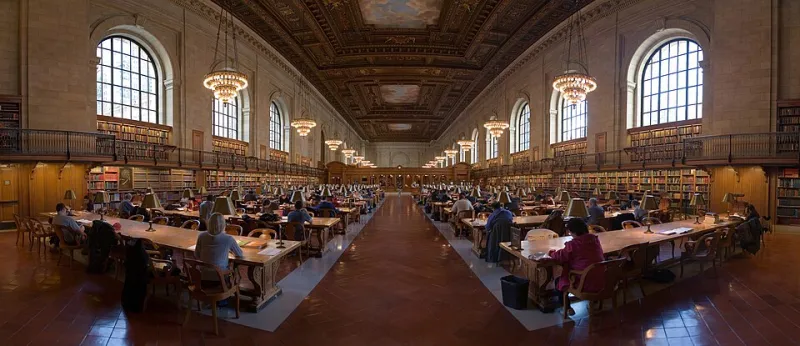
Photo: Diliff, CC BY 2.5, via Wikimedia Commons
A Different Kind of Circulation
Walk into a neighborhood branch on a weekday afternoon and the statistics on the wall tell one story: holds filled, computer sessions logged, children's programs counted. What the statistics do not capture is the cooler humming near the returns desk, stocked each morning by a partner food bank, or the shelf by the entrance where shelf-stable groceries appear without a sign-up sheet, an ID check, or a caseworker's interview.
Over the past several years, a growing number of U.S. library systems have added food to the list of things they circulate. Some host federally reimbursable summer and afterschool meal sites. Some operate small pantries or community refrigerators. Others run cooking demonstrations, food budgeting workshops, nutrition literacy series, and seed libraries. None of this appears in a strategic plan written a decade ago, yet it has become one of the most durable forms of hunger response in the country.
The reason is not sentimental. It is structural.
Why the Reference Desk Works
Food assistance in the United States is, almost by design, conditional. Applicants document income, household composition, and expenses; they recertify on schedules that rarely match the rhythms of hourly work. Libraries sit outside that architecture. A card is free. A visit requires no appointment. Nobody at the desk asks whether you deserve to be there.
That combination—universal welcome, extended hours, physical presence in nearly every census tract of consequence, and a long-earned reputation for neutrality—makes libraries unusually effective at reaching households that eligible-but-unenrolled describes precisely. Practitioners who work across both systems describe the same dynamic repeatedly: families will accept a sandwich from a librarian they see every week long before they will sit for an intake interview at a county office.
There is also the matter of geography. Branches are frequently sited near transit, schools, and senior housing, and they remain open on weekends and evenings when benefits offices are closed. In neighborhoods where the nearest full-service grocer is a bus ride away, the library may already be the most reliable public destination on the block.
Four Models, One Premise
The programs in operation today generally fall into four categories.
Hosted meal sites. A library provides space; a school district, food bank, or nonprofit acts as the sponsoring organization and handles food safety, staffing, and reimbursement. The library contributes the one thing hardest to replicate: a trusted, air-conditioned, well-located room where children and teens already feel entitled to be.
Pantry shelves and refrigerators. Smaller in scale, often stocked through a partnership with a regional food bank or a mutual-aid group. The advantage is discretion; the limitation is supply, since donated inventory is unpredictable by nature.
Skill-building programming. Cooking classes, knife-skills sessions, grocery budgeting workshops, and culturally specific recipe demonstrations. These attract audiences that would never present themselves as food-insecure—a meaningful advantage in communities where asking for help carries a cost.
Informal navigation. Reference staff helping patrons complete benefit applications, find the nearest distribution site, or print the paperwork that a portal will not accept from a phone. This labor is largely uncounted, and it is the connective tissue beneath everything else.
The Constraints Nobody Budgets For
The model's weakness is that it has grown faster than the infrastructure supporting it. Most branches were designed as reading rooms, not service kitchens. Commercial refrigeration, dry storage, and hand-washing sinks are rarely part of the original plan, and building codes do not bend for good intentions. Food safety certification, liability coverage, and waste handling all require decisions that a branch manager is seldom trained to make.
The staffing question is sharper still. Frontline library workers increasingly function as de facto social workers—fielding housing crises, mental health emergencies, and hunger—without the compensation, supervision, or boundaries that such work demands. When a refrigerator empties early, it is usually a clerk who absorbs the frustration of the people who arrived too late.
Measurement compounds the problem. Library performance is evaluated in circulation and attendance; a meal handed to a teenager does not appear in either metric. Programs that cannot be counted are programs that are easy to cut.
What Would Make It Last
Durability will depend on treating food access as an explicit line item rather than an improvisation. That means dedicated funding for equipment and staff time; formal, written partnerships that assign responsibility for food safety and supply; shared protocols that let a branch manager act without legal guesswork; and honest evaluation that counts meals served alongside books borrowed.
It also means resisting the temptation to convert libraries into general-purpose relief agencies without funding them accordingly. The sector's credibility rests on being reliably open to everyone—a promise that becomes difficult to keep when the building is asked to solve problems the surrounding institutions have abandoned.
The bhandara tradition at the heart of this organization's work makes a simple claim: a shared meal is not a transaction between the deserving and the charitable, but a practice that assumes everyone at the table belongs there. American libraries arrived at the same premise by a different route. They did not set out to become hunger infrastructure. They simply refused to turn anyone away—and in a country where so much assistance begins with a question about worth, that refusal turns out to be the whole design.