Where the Fork Meets the Floor: How Community Dining Tables Are Quietly Becoming Seats of Power
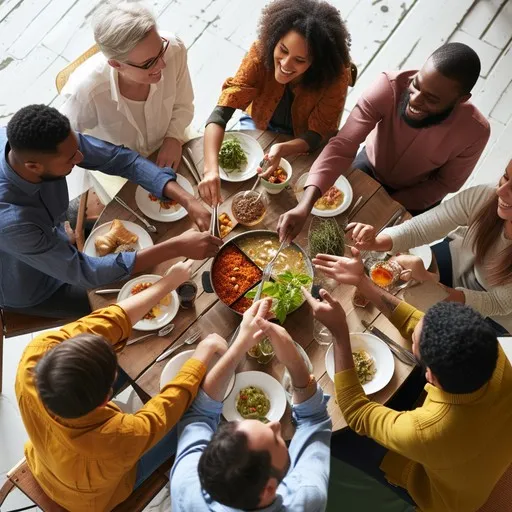
Photo: diverse community members sharing meal around dinner table civic engagement, via images.stockcake.com
A Seat at the Table, Literally
For decades, civic participation in the United States has been imagined as something that happens inside government buildings — at town halls, city council chambers, or polling stations. Yet a quieter, more intimate form of democratic engagement has been taking root in church basements, community centers, and converted warehouse spaces from Detroit to Fresno. It is happening around dinner tables, over shared plates, and through the simple, ancient act of eating together.
The concept is not new. Communal meals have long served as the connective tissue of social movements — from the freedom dinners of the Civil Rights era to the potlucks that sustained early labor organizing. What is new is the deliberate, strategic way that community organizers across the country are now designing shared eating spaces to serve an explicitly civic function: to give voice to the people most often denied it.
"When someone sits down at a table with food in front of them, something shifts," says Darnell Whitmore, a community organizer based in Cleveland who runs a weekly neighborhood dinner series for residents of a predominantly low-income zip code. "The defensiveness drops. People start talking about their real lives — their landlord, their kids' school, the bus route that got cut. And then someone says, 'Wait, what can we actually do about that?' That's where organizing begins."
The Architecture of Belonging
There is a meaningful difference between a food pantry and a dinner table. The former, however vital, often reinforces a hierarchy between giver and receiver. The latter, at its best, dissolves that hierarchy entirely. Researchers who study civic engagement and food systems have begun to document what community organizers have long understood intuitively: that the conditions created by a shared meal — physical proximity, mutual vulnerability, reciprocal nourishment — are uniquely conducive to the kind of trust that enables collective action.
Dr. Amara Osei, a sociologist at a midwestern research university who has spent several years studying food-based community organizing, describes this phenomenon as "edible solidarity." Her fieldwork, conducted across six cities, found that participants in regular communal dining programs were significantly more likely than comparable peers to attend community meetings, sign petitions, join mutual aid networks, and contact elected officials — even when those participants had previously described themselves as politically disengaged.
"Food lowers the barrier to entry," Dr. Osei explains. "You don't have to identify as an activist. You don't have to know the language of advocacy. You just have to show up hungry, and then you find out that the person next to you is fighting the same battle you are."
From Plates to Policy
The translation from shared meal to shared purpose is rarely accidental. At La Mesa Común, a community dining initiative in a predominantly Latino neighborhood on Chicago's southwest side, dinners are structured with intention. Meals rotate between participants' homes and a local community center, and each gathering includes what organizers call a "circle of concern" — a brief, facilitated conversation in which attendees raise issues affecting their daily lives. Over the past three years, these conversations have generated neighborhood petitions, a successful campaign to restore a local health clinic's funding, and a resident-led task force on utility shutoffs.
"We don't call it a meeting because people are tired of meetings," says Rosa Elena Vásquez, one of La Mesa Común's co-founders. "We call it dinner. But by the time you've eaten together, laughed together, argued a little about the food — you're already a community. The advocacy part comes naturally."
This approach reflects a growing recognition among organizers that civic participation, particularly among communities that have been historically marginalized by formal institutions, must be embedded in practices that feel safe, familiar, and dignified. For many low-income residents, immigrants, and communities of color, traditional civic spaces carry the weight of exclusion — language barriers, rigid procedural formats, and a persistent sense that their presence is tolerated rather than welcomed. A dinner table, by contrast, carries an implicit message: you belong here.
Mutual Aid as the Menu
Beyond their function as incubators of political consciousness, communal dining spaces are also increasingly serving as distribution hubs for mutual aid — the horizontal, community-driven networks of support that operate outside formal nonprofit or government structures. Participants at shared meals exchange information about legal aid, housing resources, childcare co-ops, and emergency funds. They identify neighbors in crisis and mobilize quickly. They build the kind of granular, relational knowledge of a community that no database can replicate.
In Memphis, a collective called The Common Pot hosts biweekly dinners that double as what organizers describe as "resource circles." Attendees bring not only food to share but also skills, contacts, and surplus goods. A retired nurse offers informal health consultations. A paralegal explains tenant rights. A mechanic offers discounted repairs to single-parent households. The meal is the occasion; the mutual support is the substance.
"Government programs ask you to prove you're in need," says Marcus Tillman, one of The Common Pot's organizers. "We ask you to prove you're human. That's it. Come eat, bring what you can, take what you need. Nobody's tracking you. Nobody's judging you. That's how trust gets built, and trust is how communities survive."
The Limits of the Table
For all its promise, the communal dinner table is not a panacea. Organizers are candid about the limitations. Shared meals can inadvertently reproduce the same exclusions they seek to dismantle — if language access is not provided, if dietary restrictions are not accommodated, if the location is inaccessible to people without transportation. The intimacy that makes these spaces powerful can also make them fragile; conflict, when it arises, can fracture groups that have not built the infrastructure to navigate disagreement constructively.
There is also the persistent challenge of scale. A dinner series that transforms twenty neighbors into a cohesive advocacy bloc is a meaningful achievement. But structural inequities — in housing, healthcare, wages, and food access — require interventions at a scale that no number of shared meals can single-handedly produce. Community organizers are clear-eyed about this tension, framing the dinner table not as a solution in itself, but as a foundation upon which larger, more durable forms of collective power can be constructed.
Nourishment as a Democratic Act
The Bhandara tradition, from which this organization draws its name and spirit, has always understood that feeding another person is an act of profound moral and communal significance. To offer food without conditions, to welcome the stranger to the table, to insist that no one eats alone — these are not merely gestures of charity. They are declarations of a particular kind of community: one built on mutual dignity rather than hierarchical benevolence.
What community organizers across the United States are discovering, in their dinner circles and resource tables and fellowship kitchens, is that this same logic extends into the political sphere. Democracy, in its truest sense, requires not only the formal mechanisms of voting and representation, but the lived experience of being heard, valued, and included. For communities that have been systematically denied that experience, the dinner table may be one of the most radical spaces available.
It is, after all, a place where everyone is invited to sit down — and where no one is asked to be anything other than hungry.