Same Table, Same Time: Why the Rhythm of Recurring Community Meals May Be America's Most Undervalued Social Infrastructure
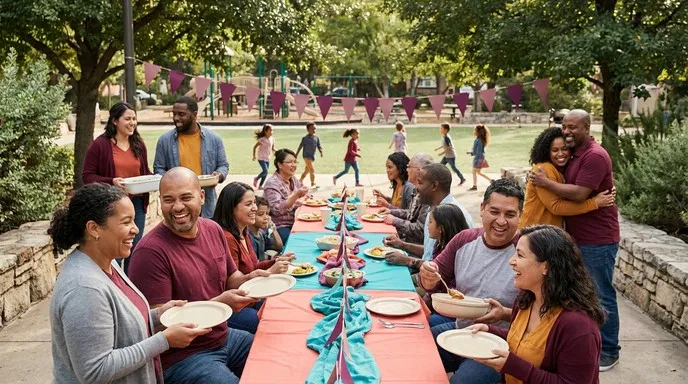
Photo: multigenerational community potluck dinner diverse neighbors sharing meal, via images.stockcake.com
There is a church fellowship hall in Columbus, Ohio, where folding tables have been arranged in the same horseshoe configuration every third Saturday for the past nineteen years. The menu changes. The volunteers rotate. The faces at the table shift with the seasons of life. But the horseshoe endures, and so does the gathering it anchors. Regulars say they do not come primarily for the food. They come because something in them expects to be there—and because they know, without having to verify it, that others will expect them too.
This quality of expectation, so easily dismissed as mere habit, turns out to be something considerably more consequential. Researchers who study the neuroscience of ritual and social bonding have begun to characterize it as a form of psychological infrastructure—invisible, difficult to quantify, and yet foundational to the kind of community cohesion that no policy document can manufacture on demand.
At Bhandara Community Hub, where the philosophy of nourishing lives and strengthening communities guides every initiative, this understanding is not abstract. It is the operational premise behind the recurring shared meals and communal dining events we help facilitate and support across the country. The evidence for why consistency matters is growing—and it deserves a serious audience.
What Ritual Does to the Brain
The word "ritual" can carry religious or ceremonial connotations that make secular community organizers hesitant to claim it. But in the behavioral sciences, ritual has a more precise and expansive meaning: any sequence of actions performed in a fixed order, with a degree of formality, that is repeated over time. By that definition, a weekly potluck is as much a ritual as a holiday feast.
Research from Harvard Business School and the University of Minnesota has demonstrated that ritual behaviors—even simple ones—reduce anxiety, increase focus, and enhance the perceived value of an experience. When people participate in a shared ritual, synchrony occurs: their heartbeats, breathing patterns, and even stress hormone levels begin to align. This physiological coordination is not metaphorical unity. It is measurable, biological solidarity.
For communities navigating food insecurity, this matters enormously. Transactional food assistance—a bag of groceries handed across a counter, a drive-through pantry pickup—addresses caloric need without engaging these deeper mechanisms. There is nothing wrong with transactional support; it saves lives. But it does not build trust, and trust, as any experienced community organizer will confirm, is the prerequisite for virtually every other form of collective resilience.
Regular communal meals do something that one-time distributions cannot: they create a reliable social environment in which vulnerability becomes safe. When a person knows that the same neighbors will be at the same table next month, the calculus of disclosure shifts. Asking for help feels less like exposure and more like a natural extension of an ongoing relationship.
The Architecture of Predictability
Organizations that have sustained recurring meal programs for a decade or more frequently describe the same phenomenon: attendance at their events is not primarily driven by hunger. It is driven by the anticipation of connection.
A community kitchen program in rural Vermont, operating since 2009, holds a monthly Sunday supper that draws between sixty and ninety participants regardless of season. The program coordinator has noted that several attendees drive more than thirty minutes each way—not because food is unavailable closer to home, but because the supper is theirs. They helped build its traditions. They remember when certain regulars were newcomers. They hold institutional memory that no newcomer possesses yet, and that memory confers both identity and responsibility.
This is precisely what developmental psychologists mean when they describe the concept of "secure base." Children who have a reliable, predictable caregiver develop the confidence to explore the world because they know where home is. The same dynamic operates in adult community life. When people can count on a recurring gathering, they are freed—psychologically and practically—to take the kinds of risks that lead to growth: volunteering, advocating, forming new relationships, trying unfamiliar foods, sharing skills they were never asked to share before.
Bridging Generations at the Table
Perhaps the most striking outcome of sustained community meal programs is their capacity to dissolve the generational segregation that characterizes much of American public life. Neighborhoods that are deeply age-stratified in nearly every other context—schools, workplaces, entertainment venues, digital platforms—often find that the shared meal table is one of the few spaces where an eighty-year-old and a twelve-year-old sit together without institutional prompting.
This proximity, repeated over months and years, produces something that formal intergenerational programming often struggles to achieve: organic knowledge transfer. Elders who would never presume to offer unsolicited life advice find themselves teaching a teenager how to roll dough. A retired nurse quietly explains medication interactions to a young parent who didn't know who to ask. A teenager helps an older neighbor navigate a smartphone to connect with distant family.
These exchanges are not programmed. They are the natural yield of consistent proximity. The meal is the occasion; the relationship is the outcome.
Community organizations that have intentionally designed their recurring meals to accommodate mixed-age participation—by scheduling at times accessible to both retirees and young families, by including activities that invite multi-generational collaboration, by honoring the culinary traditions of multiple age cohorts—report that intergenerational trust becomes self-reinforcing over time. Younger participants return because they feel respected. Older participants return because they feel needed. Both return because they feel known.
Consistency as a Form of Dignity
There is a dimension of recurring community meals that is rarely discussed in program evaluations but that participants mention consistently when asked what keeps them coming back: the simple dignity of being expected.
For individuals who have experienced housing instability, prolonged unemployment, or the chronic disorientation of poverty, the sensation of being anticipated—of having a seat held, however informally, at a table that will be there next week—is not trivial. It is, for many, a form of social recognition that other systems fail to provide. A monthly community dinner does not require an application, an eligibility determination, or a case number. It requires only presence.
This accessibility is itself a structural statement. It communicates that belonging is not conditional on need, status, or prior relationship. Everyone arrives as a participant, not a recipient. And because the gathering recurs, no single attendance carries the weight of a first impression that must be managed and performed. Regularity distributes that social labor across time, making it lighter for everyone.
Building the Infrastructure Worth Building
America invests significantly in the physical infrastructure of food assistance: warehouses, refrigerated trucks, distribution networks, point-of-sale technology for benefit programs. These investments are necessary and should be protected. But they address the logistics of food movement, not the sociology of food meaning.
The infrastructure of recurring community meals is different in kind. It is built not from concrete and capital but from commitment and calendar. It requires someone to show up, week after week or month after month, to set the table—literally and figuratively. It requires an organization willing to hold space even when attendance fluctuates, when funding is uncertain, when the path of least resistance would be to offer a one-time event and call it community engagement.
The organizations that have refused that shortcut, that have honored the unglamorous work of consistency, have built something that outlasts any single grant cycle or program initiative. They have built trust. And trust, as the science increasingly confirms and as communities have always known, is the most durable resource a neighborhood can possess.
At Bhandara Community Hub, we remain committed to supporting the programs and practitioners who understand this—who know that the table set today is an investment in the community that will gather around it for years to come.